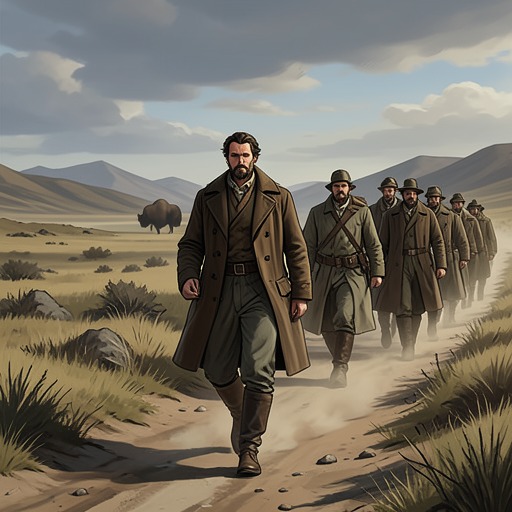
Large-scale bison hunt in the valley
Butcher's CrossingThe large-scale bison hunt in Bison Valley is the expedition’s central act of destruction: Miller drives the valley herd toward extermination, while William Andrews helps turn the killing into a growing stockpile of hides. The hunt joins a bodily, day-by-day campaign to a commercial chain reaching from the valley to distant buyers—and exposes how little control the hunters have over either the animals’ future or the market’s demands.
Commercial Hunting and the Valley’s Herd
The expedition’s hunt begins against a history of rapid depletion. Miller recalls that when he and J.D. McDonald arrived in Kansas four years earlier, the spring plains had been black with bison for miles. A two-week hunt could then yield a thousand or fifteen hundred animals and produce valuable spring hides. By the time he tells William Andrews this, the herds have dwindled to small groups, and a successful hunt brings only two or three hundred. Miller expects that within another year or two there will be no bison left to hunt in Kansas. His warning makes the valley hunt both a continuation of an established trade and a search for a remaining concentration of animals beyond the depleted plains.
McDonald’s business gives the hunt a specific commercial route. He buys and resells bison hides, processes them himself, and sells them wholesale in Saint Louis. He says he handled nearly one hundred thousand hides the previous year and expects two or three times that volume in the current one. Miller distinguishes his own independent hunting from McDonald’s organized expeditions, which pay fifty cents per head for raw summer hides and send thirty or forty parties into the country. The trade can generate a great many hides, but its rewards are unevenly divided: Miller says the hunters working for McDonald may be lucky to make it through the winter.
For the valley expedition, Miller secures McDonald as a buyer before the party sets out. The proposed price is four dollars for each winter hide, and McDonald says he already has an eastern buyer. The agreement gives the hunt an immediate financial purpose and a destination for its product; the animals killed in the valley are not merely food or trophies, but inventory intended for transport and resale. Later, Miller will insist that the expedition has three thousand prime winter hides worth more than ten thousand dollars, showing how the scale of the slaughter is measured in a commodity whose price depends on demand far beyond the hunting ground.
The Killing Method and Its Escalation
Miller’s method depends on making the herd’s confusion work for him. Lying prone beside William Andrews, he rests his Sharps rifle in the fork of a stick and studies the animals for several minutes, choosing an active bull at the edge of the group. The shot wounds it in the belly rather than killing it at once. As the bull stumbles and falls, the other bison hesitate, then gather around it; Miller uses their uncertainty to fire repeatedly. After the first six animals are down, he has Andrews bring another rifle, more cartridges, and water. The hunt is organized as sustained labor: Andrews crawls behind Miller, retrieves spent cartridges, carries supplies, and keeps the weapon ready while Miller continues shooting.
The herd’s disorientation gives way to a running slaughter. Miller fires at other bulls, and the animals, unable to find a leader, mill and circle instead of fleeing. By the middle of the afternoon, the hunt stops only after the herd has been reduced by at least two-thirds. A broken trail nearly a mile long is covered with dead bison. Andrews’s knees are scraped raw from crawling; gunpowder smoke stings his eyes and lungs, the rifle barrel burns his palm, and the repeated shots throb in his head. Yet his physical suffering accompanies a change in perception: he begins to see Miller not as acting from an ordinary appetite for hides or profit, but as an impersonal mechanism driven by the moving herd. Watching himself serve that mechanism, he no longer understands who he is or where he is going.
Miller’s single-mindedness also turns the hunt into a source of immediate danger between the men. When Fred Schneider crawls away, Miller warns him to move quietly or risk being shot if he frightens the bison. Schneider obeys, withdrawing on his knees while muttering to himself. The warning makes plain that the herd’s movement has become Miller’s overriding concern: even a companion’s safety is subordinated to keeping the animals within reach. By the time the firing ends, the scene has passed beyond the scale of a successful hunt into a mass killing whose physical cost Andrews has endured at close range.
Miller calls it his greatest hunt and asks Andrews to count the dead. Andrews manages to count to about thirty before the sheer number of bodies overwhelms his attention; the figures scatter in his mind, and he gives up. The men walk down the valley through animals lying so close together that some bodies touch. This failed count is more than a practical difficulty: the scale of the slaughter defeats the ordinary act of numbering, even as the hunt itself has made counting central to its purpose. Miller’s satisfaction at the result and Andrews’s inability to take it in mark sharply different responses to the same field of corpses.
The campaign continues beyond that first afternoon. Day by day the hunters drive the herd farther into the valley, leaving earlier and riding for more than an hour to reach its main body by the middle of the first week. Miller insists on pushing the bison down-valley so they cannot scatter into small groups, which would make them harder to kill. As the animals instinctively press toward the pass, the hunters meet them each morning and force them back toward the steep southern ridge; these frontal attacks serve mainly as a diversion, since the herd advances again while grazing at night. The intended enclosure tightens even as the animals search blindly for an exit.
The original herd of about five thousand dwindles to fewer than three hundred by the hunters’ twenty-fifth day in the mountains. After more than three weeks, the survivors have begun splitting into small bands, and Miller rarely kills more than twelve or fourteen at a time; the slow work of moving between groups replaces the opening campaign’s pace. The reduction does not make him relent. Andrews understands that Miller will not leave while a single bison remains alive, and the shrinking herd becomes the measure by which he imagines the expedition’s duration. The hunt’s endpoint is therefore not set by a planned limit or a changing season, but by the destruction of the herd itself.
Processing the Kill and the Market’s Reversal
The shooting was only the first stage of the work. Every two or three days, Charley Hoge hitched the oxen to the wagon and followed the irregular trail of hides left drying on the ground. William Andrews and Fred Schneider, sometimes joined by Miller, gathered them as the wagon crept along. Back at camp, the men stacked the hides in piles seven or eight feet high; each pile held between seventy-five and ninety hides and was bound with strips cut from a fresh hide, threaded through cuts in the upper and lower hides and pulled tight. The stacks were so heavy that all four men were needed to handle them. The landscape of the hunt was thus converted, piece by piece, into freight.
The pace of killing steadily outran the labor of preparing its products. As Miller drove the herd farther down the valley, Andrews and Schneider had to skin more animals in less time, often failing to finish before dark. They rose before dawn to butcher carcasses that had stiffened overnight, while Miller’s rifle kept hammering across the valley. He went out with two rifles and fired until their barrels grew nearly molten; the men who followed behind him worked through bodies and hides to keep up. The effort made the hunt a system of interlocking tasks—shooting, skinning, drying, hauling—in which the accumulation of hides depended on the exhausted labor of the whole party.
That system also transformed the valley into a graveyard whose scale became ordinary through repetition. Andrews saw bare carcasses spread across the ground, their rancid smell so familiar that he scarcely noticed it, while the surviving bison grazed placidly among the dead on grass stained with dried brown blood. He had not imagined that the herd could be killed to its last animal; now he recognized that Miller would not leave while any remained. The diminishing number of living bison, rather than the passing days, became Andrews’s measure of how long they would stay. The hunt’s apparent productivity and its ecological endpoint were the same process: every new stack of hides corresponded to a smaller remnant of the herd.
The commercial value that had organized the expedition proved less durable than the hunters assumed. McDonald had agreed to buy winter hides for four dollars apiece, and Miller later insisted that the three thousand prime hides left in the mountains represented more than ten thousand dollars. But McDonald told him that demand for bison fur had collapsed: people who wanted such pelts had already bought them, and no one wanted more. He compared the change to the decline of beaver fur after beaver hats went out of fashion, arguing that the hunters could not know how quickly consumers’ tastes would turn. The promised price was no longer a dependable measure of what the expedition had produced.
The railway sharpened the irony. Its track was being laid fifty miles north, but the new market it brought was for bison meat: hunters sold the meat to the railway company and left the hides to rot where they had skinned the animals. McDonald pointed out that the expedition might have earned nearly five cents a pound for meat that had been abandoned to flies and gray wolves. A trade organized around hides had rendered the rest of each carcass nearly worthless to the hunters, even as another buyer appeared for it. The valley’s slaughter had generated an immense stockpile, but neither the earlier agreement nor the coming railway could make that stockpile valuable once the market had shifted.
The Landscape Left Behind
The hunt’s damage is measured not only in the living herd’s collapse but in the remains already scattered across the Kansas plains. Miller recalls that during the great hunts, mountains of bison bones stretched as far as the eye could see; as recently as five or six years earlier, riders crossed them from Pawnee Fork to the end of the Smoky Hill. At the valley’s edge, he kicks a rib from the skeleton of a bull he estimates weighed two thousand pounds, turning the old landscape of abundance into a ruinous record of what hunting has done.
Even the bones carry competing histories of use and waste. Miller recalls that Indigenous people made needles, knives, arrow points, necklaces, toys, and combs from them, joining bone with horn and polishing pieces for use. He imagines a farmer gathering what remains to spread as fertilizer, though he doubts it will be of much use. The bone thrown into the grass catches the sunlight for an instant before falling: a small image of the hunt’s larger transformation, in which a living animal is reduced first to saleable hides and then to remnants with little value to the men who killed it.